
Movie spotlight
Kitchen Stories
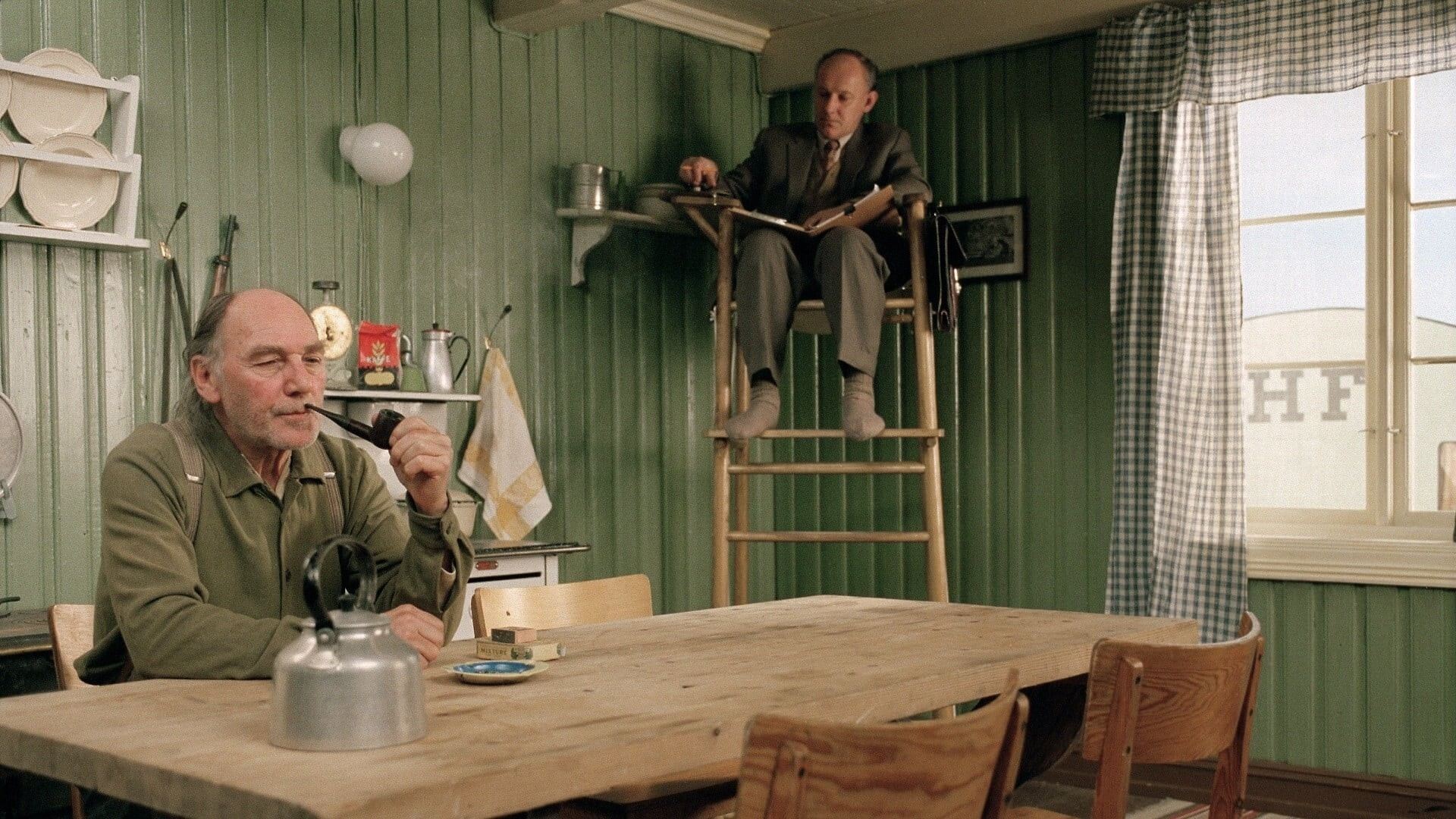
Swedish efficiency researchers come to Norway for a study of Norwegian men, to optimize their use of their kitchen. Folke Nilsson (Tomas Norström) is assigned to study the habits of Isak Bjørvik (Joachim Calmeyer). By the rules of the research institute, Folke has to sit on an umpire's chair in Isak's kitchen and observe him from there, but never talk to him. Isak stops using his kitchen and observes Folke through a hole in the ceiling instead. However, the two lonely men slowly overcome the initial post-war Norwegian-Swede distrust and become friends.
Insights
Plot Summary
In the 1950s, Sweden launched a scientific study to observe the eating habits of single men in their homes. The researchers set up observation posts in the kitchens of various subjects, aiming to understand their routines and behaviors. However, the meticulously planned experiment begins to unravel as the observers and the observed develop an unexpected, and increasingly blurred, relationship.
Critical Reception
Kitchen Stories was generally well-received by critics for its quirky humor, unique premise, and charming performances. Reviewers often highlighted its gentle, observational style and its ability to blend comedy with poignant moments about human connection and loneliness.
What Reviewers Say
Praised for its dry, observational humor and endearing characters.
Appreciated for its thoughtful exploration of human connection and isolation.
Noted for its unique and whimsical premise that unfolds gently.
Google audience: Google users largely appreciated the film's originality, its subtle humor, and the heartwarming interactions between the observers and the observed. Many found it to be a charming and thought-provoking character study.
Awards & Accolades
Selected as the Norwegian entry for the Best Foreign Language Film at the 76th Academy Awards, though it was not nominated. It also received awards at various film festivals.
Fun Fact
Director Bent Hamer was inspired by a real-life Swedish study from the 1950s that investigated the eating habits of single men, which was part of a broader effort to understand societal behaviors at the time.
AI-generated overview · Verify ratings on official sources