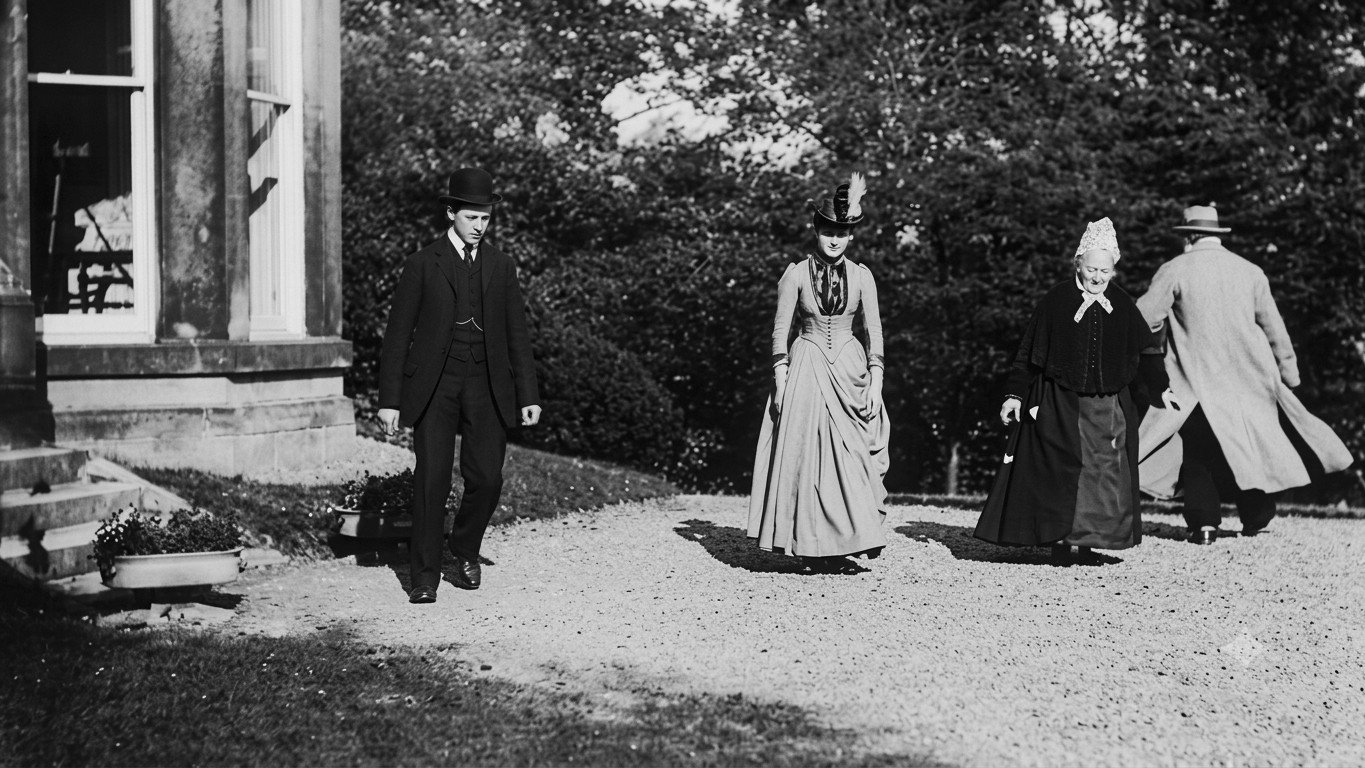
Roundhay Garden Scene

Roundhay Garden Scene

1888Movie1 minEnglish

The earliest surviving motion-picture film, and believed to be one of the very first moving images ever created, was shot by Louis Aimé Augustin Le Prince using the LPCCP Type-1 MkII single-lens camera. It was taken on paper-based photographic film in the garden of Oakwood Grange, the Whitley family house in Roundhay, Leeds, West Riding of Yorkshire (UK), on 14 October 1888. The film shows Adolphe Le Prince (Le Prince’s son), Mrs. Sarah Whitley (Le Prince’s mother-in-law), Joseph Whitley, and Miss Harriet Hartley walking around in circles, laughing to themselves, and staying within the area framed by the camera. Roundhay Garden Scene is often associated with a recording speed of around 12 frames per second and runs for about 2 to 3 seconds.

Read Reviews

Insights

IMDb6.0/10
Director: Louis Le PrinceGenres: Short, Documentary, Silent Film

Plot Summary

This groundbreaking film captures a brief moment in time at Oakwood Grange in Roundhay, Leeds. It features Adolphe Le Prince, Sarah Whitley, Joseph Whitley, and Harriet Hartley walking in the garden. The scene is notable for its simplicity and its status as one of the earliest known motion pictures.

Critical Reception

As the first surviving motion picture, 'Roundhay Garden Scene' is primarily recognized for its immense historical significance rather than critical acclaim in the traditional sense. Its value lies in its pioneering status as a precursor to modern cinema.

What Reviewers Say

  • Recognized as the earliest surviving film, its historical importance is unparalleled.
  • A crucial artifact in the development of cinematic technology.
  • Offers a unique glimpse into everyday life over a century ago.

Google audience: As an artifact of early film, viewers recognize its historical value and pioneering nature, though it is not reviewed in the context of modern filmmaking standards.

Awards & Accolades

Considered the oldest surviving film in existence, it is a foundational work in film history.

Fun Fact

The film was shot on Eastman Kodak photographic paper using a single-lens camera, predating Thomas Edison's work on the kinetoscope.

AI-generated overview · Verify ratings on official sources

My Review