
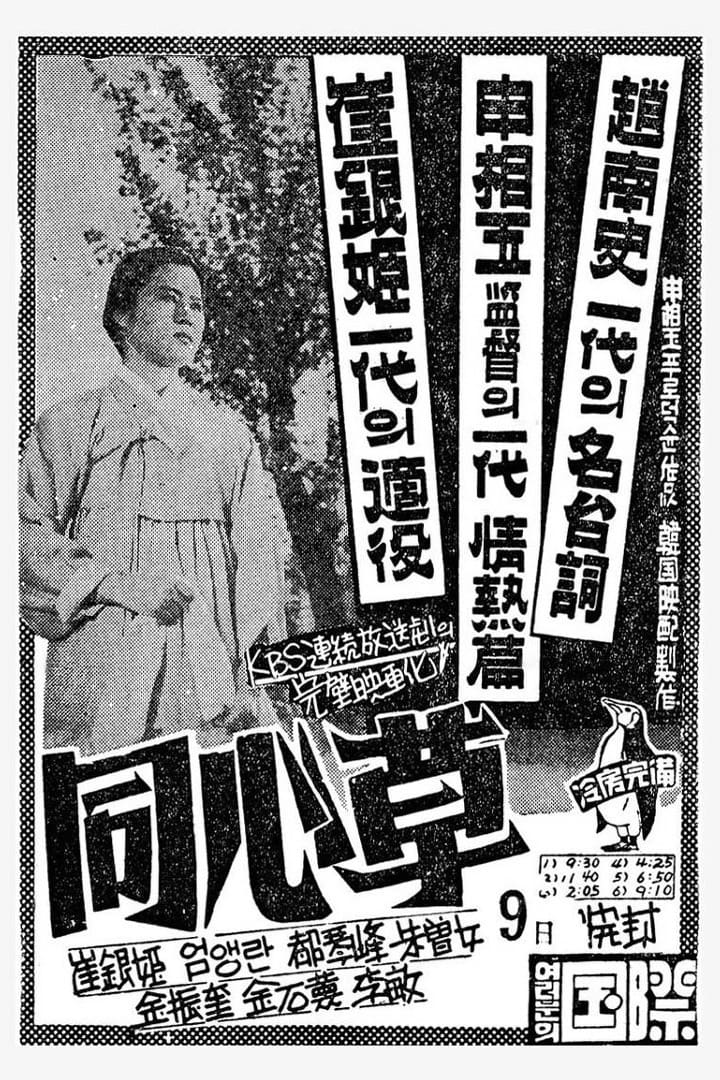
Movie spotlight
Dongsimcho
Lee Suk-hui (Choe Eun-hui) lost her husband to the Korean War eight years ago. She runs a dressmaking shop that has fallen into debt. When Kim Sang-gyu (Kim Jin-gyu), the executive director of a publishing company, helps her pay off debts, she falls in love with him. He, however, is engaged to the daughter of his boss, Ok-ju (Do Geum-bong). His sister (Ju Jeung-nyeo) pushes him to marry the boss's daughter, hoping that will bring him rapid success. Meanwhile, Suk-hui's grown-up daughter Gyeong-hui, wanting her mother to be happy, urges her mother to marry Sang-gyu, but Suk-hui vacillates between social mores and her own happiness. Even though she and Sang-gyu truly love each other, she decides to leave him and heads for her country home after selling her house in Seoul. Hearing the news, he who is ill in bed hurries to Seoul station, but it is too late. All he can do is just to stand on the platform and to watch her train pulling away.
Insights
Plot Summary
The story centers on a young woman who is in love with a painter, but her family pressures her into marrying a wealthy man. She struggles to reconcile her personal desires with the expectations placed upon her. The film explores themes of sacrifice, societal pressure, and the enduring nature of true love amidst adversity.
Critical Reception
While specific critical reviews from 1959 are scarce, "Dongsimcho" is remembered as a significant melodrama in early South Korean cinema, resonating with audiences for its emotional depth and exploration of societal constraints on personal relationships.
What Reviewers Say
Praised for its emotional storytelling and portrayal of societal conflicts.
Considered a notable example of Korean melodrama from its era.
The film effectively captures the struggles of young love against traditional expectations.
Google audience: Information regarding Google user reviews for this film is not available due to its age and limited international distribution.
Fun Fact
The film's title, "Dongsimcho," translates to "Wild Ginger Flower," often symbolizing enduring love and faithfulness in Korean culture.
AI-generated overview · Verify ratings on official sources