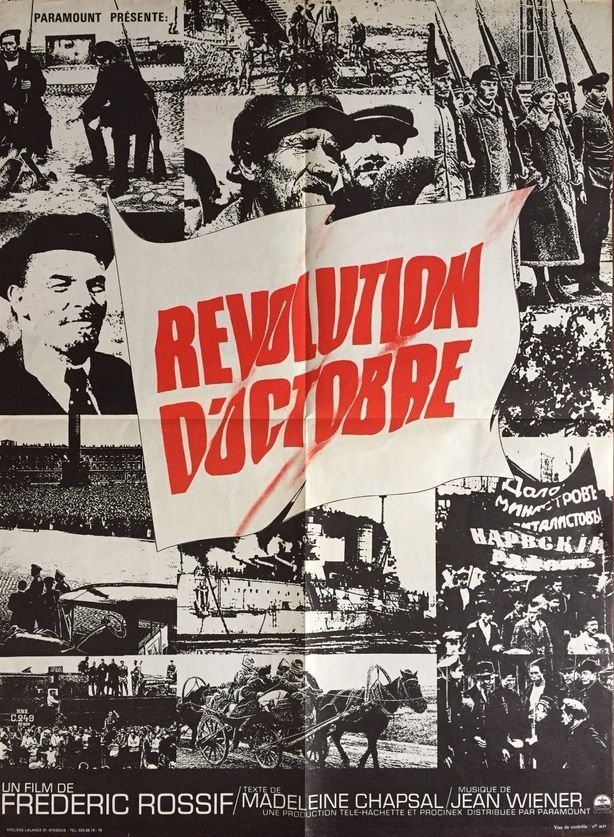

October Revolution
French director Frederic Rossif presents this historical documentary that coincided with the 50th anniversary of the Russian Revolution. Stock footage from both World Wars are included with 30 minutes of new scenes filmed especially for the project. The historical timeline is traced from the time Czar Nicholas II is crowned. The emergence of Lenin, his death in 1924, and the later contributions of Trotsky and Stalin give the viewer a sense of death, betrayal, and ideological devotion to the communist agenda. Rossif effectively uses scenes from the landmark 1929 film The Man With A Movie Camera by celebrated director Dziga Vertov. Rossif researched the film archives from several countries in his meticulous gathering of materials for this timely historical feature.
Insights
Plot Summary
This seminal documentary, helmed by the legendary Sergei Eisenstein, chronicles the dramatic events of the 1917 October Revolution in Russia. It meticulously reconstructs the political turmoil, the storming of the Winter Palace, and the subsequent establishment of Soviet power through a powerful combination of archival footage, staged re-enactments, and Eisenstein's signature montage techniques. The film offers a stark and potent visual narrative of a pivotal moment in 20th-century history.
Critical Reception
While initially released in 1927, the film was re-edited and re-released with additional sound and narration in 1967. The original film is celebrated for its groundbreaking cinematic techniques and historical significance. The 1967 version, while preserving much of Eisenstein's original vision, is often viewed through the lens of its historical context and Eisenstein's later career.
What Reviewers Say
- Praised for its revolutionary editing and visual storytelling.
- Recognized as a vital historical document and a masterpiece of Soviet cinema.
- Its political messaging and artistic style continue to be subjects of academic and critical discussion.
Google audience: Information regarding specific Google user reviews for this film is not readily available.
Awards & Accolades
None notable (original film received critical acclaim and influenced filmmaking significantly, but specific awards for the 1967 re-release are not widely documented).
Fun Fact
Sergei Eisenstein employed a technique known as intellectual montage, where the juxtaposition of disparate images creates new meanings and emotional impact, which was highly influential on filmmakers worldwide.
AI-generated overview · Verify ratings on official sources