
Movie spotlight
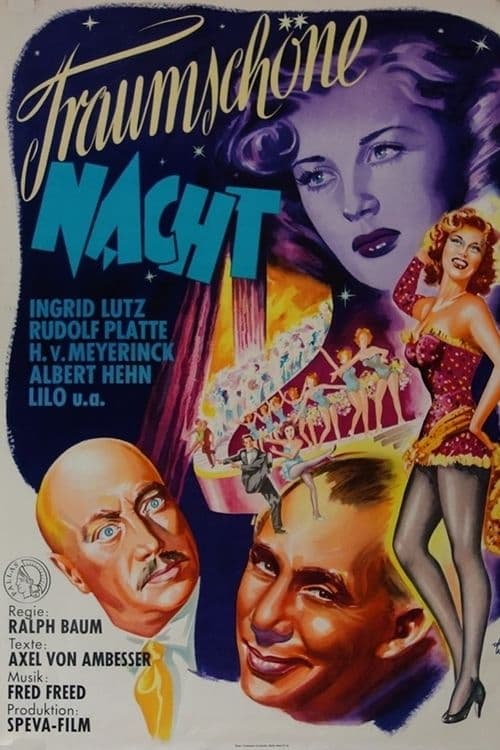
Traumschöne Nacht
Peter is a talented young composer who has so far not been able to get his revue “Traumschöne Nacht” in a music theatre. Behind the scenes of the “Alhambra”, a Paris music hall, he meets Violetta, a young up-and-coming artist. For her sake, Mr. Maroni, the director of the “Alhambra”, who is in love with Violetta but is rejected by her, has organized a costume party at which the young entertainer appears as a little flower seller. When Peter shows up there too, he believes that Violette is actually selling flowers.
Insights
Plot Summary
A charming comedy revolving around mistaken identities and romantic entanglements in a picturesque setting. The story follows a young woman who finds herself drawn into a series of amusing situations when she meets two very different men. As misunderstandings pile up, she must navigate her feelings and uncover the truth behind their true intentions.
Critical Reception
This film was a lighthearted romantic comedy that found favor with audiences of its time for its charming performances and pleasant storyline. Critically, it was seen as a typical, enjoyable German production of the era, offering escapism and gentle humor without aiming for profound artistic statements.
What Reviewers Say
Praised for its light-hearted and amusing romantic plot.
Appreciated for the pleasant performances of its lead actors.
Seen as a charming and entertaining film typical of post-war German cinema.
Google audience: Audience reception information for this film is not readily available through modern aggregated reviews. However, based on its genre and release era, it was likely enjoyed as a pleasant romantic diversion.
Fun Fact
The film benefited from the popularity of its leading actors, Maria Holst and Rudolf Prack, who were well-established stars in German cinema during the 1950s.
AI-generated overview · Verify ratings on official sources