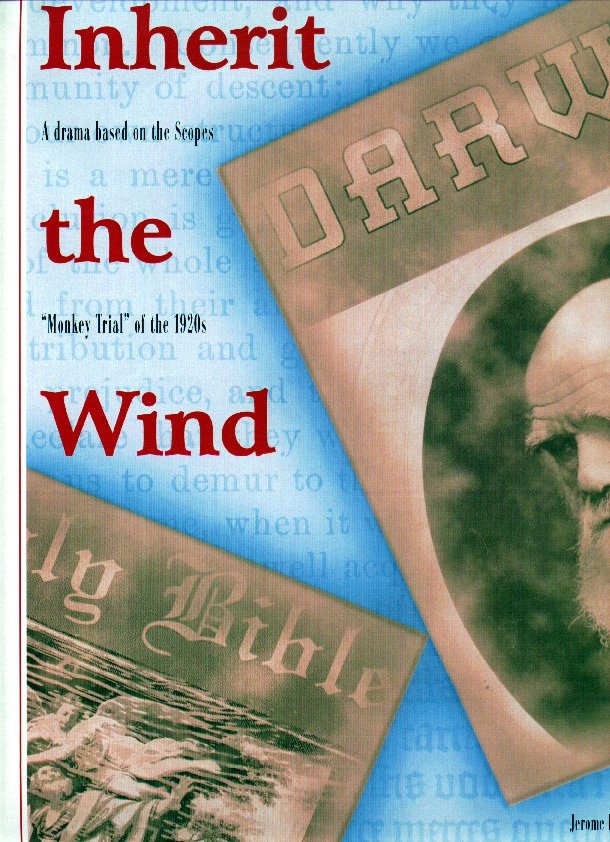

Inherit the Wind
A young man, Bert Cates, is arrested in a small Bible Belt town for teaching the theory of Evolution in the public school. Two of the finest legal minds in the U.S. are called to the trial: Henry Drummond for the defense, and Matthew Harrison Brady for the prosecution. The trial proceeds on three levels, the guilt or innocence of Cates, the issue of the Bible vs. Darwin, and finally, the personal confrontation between Drummond and Brady.
Insights
Plot Summary
In the fictional town of Hillsboro, a passionate and controversial trial unfolds when a schoolteacher is accused of teaching evolution. The case pits a celebrated prosecutor, Henry Drummond, against his old rival, Matthew Harrison Brady, drawing national attention and igniting a fierce debate between faith and reason. As the trial progresses, the town's deep-seated beliefs are challenged, and the core principles of freedom of thought and justice are put to the test.
Critical Reception
Inherit the Wind was met with critical acclaim for its powerful performances, sharp dialogue, and thought-provoking exploration of intellectual freedom and religious fundamentalism. While it was a box office disappointment, its themes resonated deeply, establishing it as a significant film that continues to be studied and discussed for its relevance to societal debates.
What Reviewers Say
- Praised for its intelligent script and strong thematic content.
- The performances, particularly Spencer Tracy and Fredric March, are widely lauded.
- Critiqued by some for its historical inaccuracies and heavy-handed moralizing.
Google audience: Audiences appreciate the film's intellectual depth and the compelling courtroom drama, finding its themes of freedom of speech and thought to be enduring and important. Some viewers note the film's theatrical origins and direct confrontation of religious dogma.
Awards & Accolades
Nominated for Academy Awards for Best Actor (Spencer Tracy) and Best Film Editing. Won awards at the Venice Film Festival for Spencer Tracy and for Best Screenplay.
Fun Fact
The film is a dramatization of the 1925 Scopes Trial, but it is not a direct adaptation. The characters are fictionalized versions of real historical figures, and the trial's outcome is altered to serve the film's dramatic and thematic purposes.
AI-generated overview · Verify ratings on official sources