
Movie spotlight
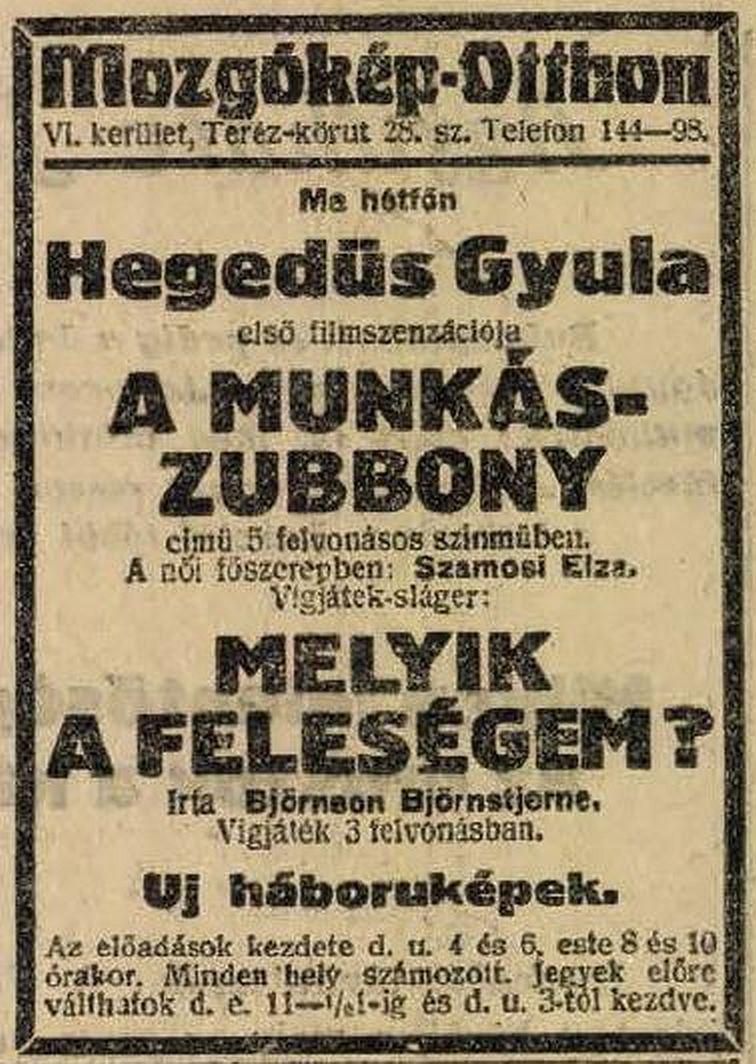
The Workman’s Overall
The romantic adventures of a wealthy factory owner with a beautiful Gypsy girl, who, overcome with jealousy, kidnaps the man’s child while he investigates (incognito) the disloyal and corrupt foreman in his own factory. His disguise is his old work overall in which he started his career many years before. The dramatic and spectacular work is the earliest surviving feature in Hungarian film history, starring legendary figures from the Hungarian stage: Gyula Hegedűs, who has a street named after him in Budapest, and Elza Szamosi, one of the first Puccini female singers of American and European opera stages.
Insights
Plot Summary
This short silent comedy likely depicted a humorous situation involving a workman and his overall, a common garment in the early 20th century. Given the era and genre, the film probably relied on slapstick and visual gags for its humor, focusing on everyday scenarios that would resonate with audiences.
Critical Reception
As a very early silent short film, "The Workman's Overall" is not widely reviewed or critically analyzed in modern terms. Such films were primarily produced for mass entertainment and relied on their immediate comedic impact rather than enduring critical acclaim. Detailed contemporary reviews are scarce, making a comprehensive critical reception difficult to ascertain.
What Reviewers Say
Likely a simple, character-driven comedy.
Relied on visual humor typical of early cinema.
A minor piece from the silent film era.
Google audience: Information regarding Google user reviews for this specific 1915 film is not available. Early silent films rarely have audience ratings or reviews preserved in a way that is accessible today.
Fun Fact
The "overall" depicted in the film would have been a garment designed for manual labor, often a one-piece suit made of durable fabric like denim or canvas, evolving into the overalls or dungarees commonly known today.
AI-generated overview · Verify ratings on official sources